"Aided by at least $43 million in assistance from the government of Massachusetts and an innovative solar energy technology, Evergreen Solar emerged in the last three years as the third-largest maker of solar panels in the United States.
But now the company is closing its main American factory, laying off the 800 workers by the end of March and shifting production to a joint venture with a Chinese company in central China. Evergreen cited the much higher government support available in China."
"A mortgage note is the document you signed when you purchased your home loan. Mortgages contain lots of paperwork – but only the original mortgage note with your signature is proof that you owe the debt. That’s why banks need the note to prove that they own the loan and can collect payments from you. The problem is, banks now buy and sell mortgages up and down Wall Street – slicing them up and repackaging them to sell to other banks. The bank you bought your mortgage from two years ago may not be the bank that owns it today. But, in all the shuffle, the mortgage notes often don’t get transferred along with your debt."
Maybe there'll be a return to dark age European legal procedure like trial by combat or trial by ordeal, methods prior to the development of common law by Crusader and Norman influence of Roman and Sicilian Islamic law (shariah law!).
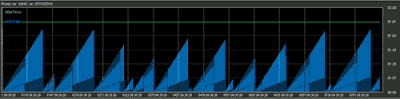
"Mysterious and possibly nefarious trading algorithms are operating every minute of every day in the nation's stock exchanges.
What they do doesn't show up in Google Finance, let alone in the pages of the Wall Street Journal. No one really knows how they operate or why. But over the past few weeks, Nanex, a data services firm has dragged some of the odder algorithm specimens into the light.
The trading bots visualized in the stock charts in this story aren't doing anything that could be construed to help the market. Unknown entities for unknown reasons are sending thousands of orders a second through the electronic stock exchanges with no intent to actually trade. Often, the buy or sell prices that they are offering are so far from the market price that there's no way they'd ever be part of a trade. The bots sketch out odd patterns with their orders, leaving patterns in the data that are largely invisible to market participants.
In fact, it's hard to figure out exactly what they're up to or gauge their impact. Are they doing something illicit? If so, what? Or do the patterns emerge spontaneously, a kind of mechanical accident? If so, why? No matter what the answers to these questions turn out to be, we're witnessing a market phenomenon that is not easily explained. And it's really bizarre."
"an open, collaborative site aims at establishing standards of practice for employers and employees in the motion design industry, including freelance animators, designers, art directors, and visual effects artists.The site's goals include:
creating an organized repository of best practices for motion design employers and employees.
providing practical tips for freelancers and contract artists.
establishing and discussing ethical and professional standards for the motion design industry."
It's so over, making this post a bit repetitive, but hey...
Conditions can be tough for people working in advertising and visual effects as economic and technological pressures realign the industries. A flurry of stories last month (see FX industry troubles: Lee Stranahan, Scott Ross + editing), culminated in a VFX TownHall meeting last night.
Update: via @alba #vfxtownhall sprouting corridors in every direction [Wednesday] tonight 7:30pm PST @dorkmanscott doing panel @ http://downinfront.net/vfx/ via @neonmarg
Update 2: Scott Squires, with VFX experience ranging from Close Encounters to Fantastic Four: Rise of the Silver Surfer, posted VFX TownHall Meeting thoughts [and later added more].
A few days ago Bill Moyers interviewed economics professor William K. Black, who says that 'it was more than greed and incompetence that brought down the U.S. financial sector and plunged the economy in recession ... at the very center of mortgage collapse, creating triple-A rated bonds out of "liars' loans" — loans issued without verifying income, assets or employment — was a fraud, and the banks knew it.'
Black says the fraud had 3 stages: "the way that you do it is to make really bad loans, because they pay better. Then you grow extremely rapidly, in other words, you're a Ponzi-like scheme. And the third thing you do is we call it leverage. That just means borrowing a lot of money, and the combination creates a situation where you have guaranteed record profits in the early years. That makes you rich, through the bonuses that modern executive compensation has produced. It also makes it inevitable that there's going to be a disaster down the road."
Black also comments on the foxes guarding the hen house; see this excerpt or the entire QuickTime version at Moyers Journal:
"The crash has laid bare many unpleasant truths about the United States. ...the finance industry has effectively captured our government—a state of affairs that more typically describes emerging markets, and is at the center of many emerging-market crises. If the IMF’s staff could speak freely about the U.S., it would tell us what it tells all countries in this situation: recovery will fail unless we break the financial oligarchy that is blocking essential reform. And if we are to prevent a true depression, we’re running out of time."
<Update\: Elizabeth Warren's 8-minute video summary of a congressional panel report, via Mike Whitney /update end>
Despite the morass, there are plenty of options -- it's not like the country has been destroyed in a Mongol Invasion like medieval Baghdad. As noted earlier among other good news, SF Bay's Van Jones was appointed Special Advisor for Green Jobs, Enterprise and Innovation by the White House. Jones advocates another type of stimulus -- investments in people and green infrastructure rather than bailouts.
'Chicken Little, don your hardhat. Nudged by recession, doom has arrived. The toll will be so vast -- and the institutions of media and marketing are so central to our economy, our culture, our democracy and our very selves -- that it's easy to fantasize about some miraculous preserver of "reach" dangling just out of reach. We need "mass," so mass, therefore, must survive. Alas, economies are unsentimental and denial unproductive. The post-advertising age is under way. This isn't about the end of commerce or the end of marketing or news or entertainment. All of the above are finding new expressions online, and in time will flourish thanks to the very digital revolution that is now ravaging them. The future is bright. But the present is apocalyptic. Any hope for a seamless transition -- or any transition at all -- from mass media and marketing to micro media and marketing are absurd. The sky is falling, the frog in the pot has come to a boil and, oh yeah, we are, most of us, exquisitely, irretrievably f*#$ed [bleep].'
PrepShootPost notes that with a down economy the New York City art world is going back to the drawing board and links to a NYT article, The Boom Is Over. Long Live the Art! Looks like many people will now have time for art.
Via Images to Live By is Bill Viola: ‘Ocean without a shore’, where Viola combines analog and high-def digital video of people passing through a water wall, akin to a wall of death. More on this can be found at Images to Live By; other work (and background) by Viola was at SFMOMA, which has interactive and video of all sorts archived.
"Reverse graffiti is form of street art that involves carving into the dirt and dust that surrounds us. Artists subtract from a surface in order to create a negative image within the positive, often quite dark layer of grime."
 The New York Times reports on the invisible hand of the free market in Solar Panel Maker Moves Work to China: